
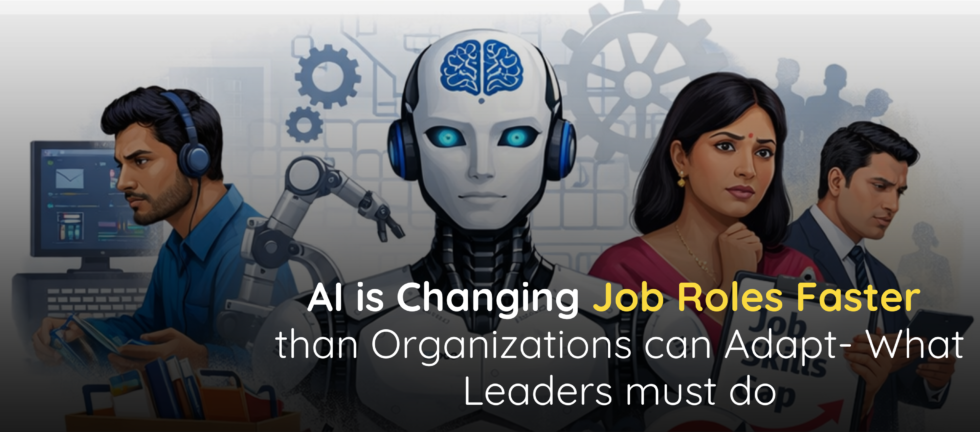
Artificial Intelligence is no longer a future trend.
It is actively reshaping how work gets done—across industries, functions, and roles.
From automation of routine tasks to augmentation of decision-making, AI is changing not just what we do—but how we do it.
But here’s the real challenge:
Job roles are evolving faster than organisations are able to adapt their people.
The Speed Mismatch That Leaders Must Recognise
In many organisations today:
- Job descriptions are becoming outdated within months
- New tools are introduced faster than teams can absorb them
- Employees are expected to adapt without structured support
- Learning systems struggle to keep pace with change
As a result, a gap emerges—not of technology, but of capability alignment.
AI doesn’t replace entire jobs overnight.
It reshapes roles gradually, demanding new skills, new thinking, and new ways of working.
The question is: Are organisations evolving at the same pace?
Why Traditional Workforce Models Are Falling Behind
Most workforce systems were designed for stability.
- Roles were clearly defined
- Skills remained relevant for longer periods
- Training could be planned annually
- Change was incremental
AI has disrupted all of this.
Today:
- Roles are fluid
- Skills are constantly evolving
- Learning must be continuous
- Adaptability is more valuable than expertise alone
Yet many organisations are still operating with static workforce structures in a dynamic environment.
What Leaders Must Do Differently
Adapting to AI is not just about adopting technology.
It is about redesigning how organisations build capability.
Leaders need to focus on:
👉 Building learning-centric work environments
Where learning is embedded into daily work—not separated from it.
👉 Shifting from role-based to capability-based thinking
Preparing people for evolving responsibilities, not fixed job descriptions.
👉 Enabling continuous skill development
Moving beyond one-time training programs to ongoing learning journeys.
👉 Creating safe environments to learn and adapt
Allowing teams to experiment, fail, and improve as roles evolve.
The Workforce Advantage in the AI Era
In a world where technology is widely accessible, competitive advantage will not come from AI alone.
It will come from how effectively organisations enable their people to work alongside AI.
Those that adapt faster will:
- Unlock higher productivity
- Respond better to change
- Build resilient and future-ready teams
Those that don’t will struggle—not because they lack technology, but because they lack prepared talent.
A Leadership Reflection
AI is not just a technological shift.
It is a workforce transformation moment.
The real question for leaders is:
- Are we preparing our people for the jobs AI is creating—while those jobs are still evolving?
- Because in this transition, success will not depend on who adopts AI first.
- It will depend on who adapts their workforce fastest.
🔗 Learn more about workforce transformation and capability-building insights.