
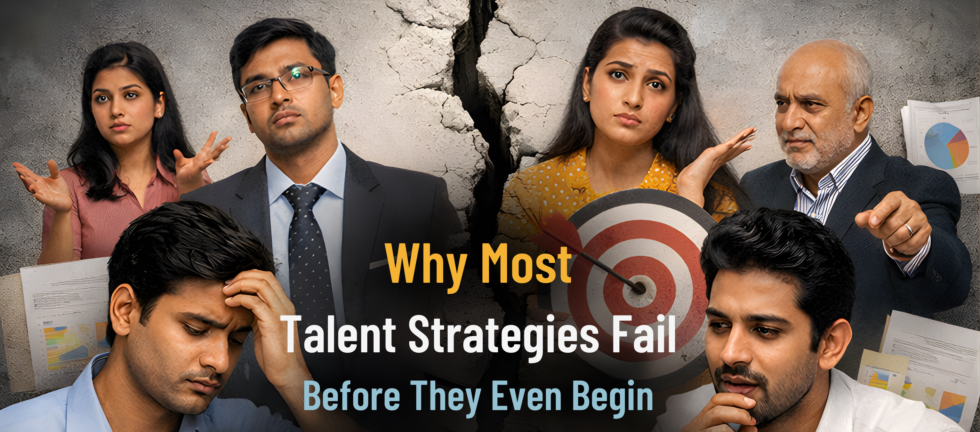
Most talent strategies don’t fail during execution.
They fail much earlier—at the thinking stage.
On paper, organisations appear well prepared: hiring plans, learning calendars, succession frameworks, and workforce dashboards. Yet the reality tells another story—high attrition, long ramp-up times, persistent skill gaps, and constant firefighting. The problem isn’t a lack of effort; it’s flawed assumptions.
One silent flaw is that talent strategy often begins after hiring, not before. Organisations focus on filling roles and expect readiness to emerge post-joining through training or trial-and-error. Another issue is planning skills in isolation from how work actually happens—on the shopfloor, in operations, or in customer-facing roles. Learning is also treated as a one-time event rather than a continuous system, while hiring success is measured by speed and cost instead of time-to-productivity and long-term performance.
By the time these gaps become visible, the organisation is already paying the price.
High-impact organisations take a fundamentally different approach. They design talent journeys, not just job descriptions. They embed learning inside real work rather than separating it from daily operations. They build talent pipelines before demand peaks and measure success by readiness, retention, and capability—not headcount alone.
In such organisations, apprenticeships, work-integrated learning, and structured on-the-job exposure are not compliance tools; they are strategic levers.
Before approving the next hiring plan or training budget, leaders must ask:
Are we solving a short-term vacancy—or building long-term capability?
Talent strategy is not an HR document.
It is a business architecture decision.
In the next decade, organisations won’t lose because they lack talent—but because they failed to design systems that create it.