
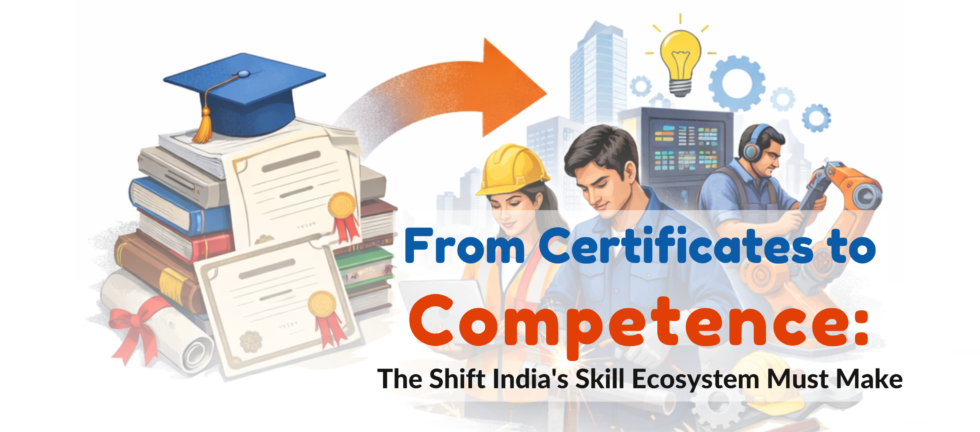
India has never issued more certificates than it does today.
Degrees, diplomas, short-term credentials, online badges—our skill ecosystem is rich in proof_of_learning.
Yet organisations across sectors continue to say the same thing:
“Certified candidates struggle to perform.”
This is not a contradiction.
It’s a warning.
The Certificate Comfort Zone
Certificates are easy to scale.
They provide structure, standardisation, and visibility.
But certificates often measure:
- Completion, not capability
- Exposure, not execution
- Knowledge, not application
As a result, many individuals enter the workforce with impressive credentials—but limited readiness for real-world responsibility.
The problem isn’t certification itself.
The problem is confusing certification with competence.
Why This Gap Hurts Everyone
For individuals:
- Confidence drops when theory meets reality
- Early failures feel personal, not systemic
- Career momentum slows despite “qualifications”
For organisations:
- Ramp-up time stretches
- Managers spend time correcting basics
- Training budgets rise without proportional impact
- Attrition increases when expectations don’t match experience
When learning stays disconnected from work, certificates lose credibility—on both sides.
What Competence Actually Looks Like
Competence is not what someone knows.
It’s what someone can consistently do under real conditions.
It includes:
- Applying skills in live environments
- Handling ambiguity and pressure
- Working with people, systems, and constraints
- Learning from mistakes and improving performance
These cannot be fully developed in classrooms alone.
They are built inside work.
Why the Ecosystem Must Shift—Now
India’s skill ecosystem needs to move from:
- Teaching content → Designing capability
- Measuring hours → Measuring readiness
- Issuing certificates → Building confidence through performance
Apprenticeships, work-integrated learning, and structured on-the-job exposure enable this shift by allowing people to learn while contributing—turning theory into habit.
This doesn’t dilute standards.
It strengthens them.
The Leadership Question Ahead
As automation and role complexity increase, leaders must ask:
👉 Are we rewarding credentials—or capability?
👉 Are we building learning pathways—or collecting certifications?
👉 Are we preparing people to pass assessments—or to perform at work?
The answers will define the future credibility of India’s skill ecosystem.
Why This Shift Matters
Certificates may open doors.
But competence sustains careers—and organisations.
India’s growth ambitions will depend not on how many certificates we issue, but on how many capable professionals we build.
The future belongs to those who can do the work—not just show proof they studied it.