
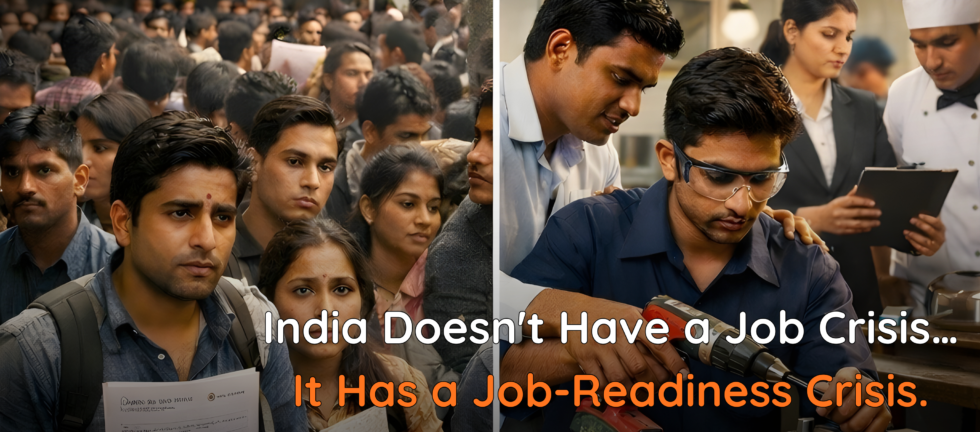
𝐓𝐡𝐞 𝐌𝐢𝐬𝐝𝐢𝐚𝐠𝐧𝐨𝐬𝐢𝐬 𝐖𝐞 𝐊𝐞𝐞𝐩 𝐑𝐞𝐩𝐞𝐚𝐭𝐢𝐧𝐠
Every few months, the same claim resurfaces: “India doesn’t have enough jobs.”
But the real issue is far more uncomfortable—and far more critical.
India doesn’t lack jobs.
India lacks 𝐣𝐨𝐛-𝐫𝐞𝐚𝐝𝐲 𝐭𝐚𝐥𝐞𝐧𝐭.
Across sectors, roles stay vacant for months while millions of young people remain unemployed. This isn’t a problem of opportunity—it’s a problem of 𝐫𝐞𝐚𝐝𝐢𝐧𝐞𝐬𝐬.
India produces one of the world’s largest graduate pools each year, yet studies show that 𝐥𝐞𝐬𝐬 𝐭𝐡𝐚𝐧 20% 𝐚𝐫𝐞 𝐞𝐦𝐩𝐥𝐨𝐲𝐚𝐛𝐥𝐞 𝐰𝐢𝐭𝐡𝐨𝐮𝐭 𝐚𝐝𝐝𝐢𝐭𝐢𝐨𝐧𝐚𝐥 𝐭𝐫𝐚𝐢𝐧𝐢𝐧𝐠. Employers consistently report that fresh hires take months to become productive, early attrition is high, and classroom learning rarely matches workplace realities. As automation, AI, and digitization accelerate, this gap is only widening.
Jobs exist. Aspirations exist.
𝐑𝐞𝐚𝐝𝐢𝐧𝐞𝐬𝐬 𝐝𝐨𝐞𝐬 𝐧𝐨𝐭.
This crisis is systemic. Education priorities degrees over delivery. Hiring screens credentials faster than competence. Training is treated as a post-joining fix instead of a design principle. Industry engagement often starts too late—after the gap has already formed.
Forward-looking organizations are changing the lens:
From hiring for jobs → 𝐛𝐮𝐢𝐥𝐝𝐢𝐧𝐠 𝐩𝐞𝐨𝐩𝐥𝐞 𝐟𝐨𝐫 𝐫𝐨𝐥𝐞𝐬
From training after joining → 𝐥𝐞𝐚𝐫𝐧𝐢𝐧𝐠 𝐰𝐡𝐢𝐥𝐞 𝐰𝐨𝐫𝐤𝐢𝐧𝐠
From short-term staffing → 𝐥𝐨𝐧𝐠-𝐭𝐞𝐫𝐦 𝐭𝐚𝐥𝐞𝐧𝐭 𝐩𝐢𝐩𝐞𝐥𝐢𝐧𝐞𝐬
Apprenticeships and work-integrated learning are proving effective because they expose learners to real work early, align skills with business needs, reduce time-to-productivity, and lower early attrition.
The future of India’s workforce won’t be decided by how many jobs we create.
It will be decided by 𝐡𝐨𝐰 𝐢𝐧𝐭𝐞𝐧𝐭𝐢𝐨𝐧𝐚𝐥𝐥𝐲 𝐰𝐞 𝐩𝐫𝐞𝐩𝐚𝐫𝐞 𝐩𝐞𝐨𝐩𝐥𝐞 𝐭𝐨 𝐩𝐞𝐫𝐟𝐨𝐫𝐦 𝐢𝐧 𝐭𝐡𝐞𝐦.
The real question for leaders isn’t “Do we have enough talent?”
It’s “𝘈𝘳𝘦 𝘸𝘦 𝘣𝘶𝘪𝘭𝘥𝘪𝘯𝘨 𝘵𝘢𝘭𝘦𝘯𝘵 𝘵𝘩𝘢𝘵 𝘪𝘴 𝘵𝘳𝘶𝘭𝘺 𝘳𝘦𝘢𝘥𝘺?”
Until that shift happens, the job-readiness crisis will keep masquerading as a job crisis—and India’s demographic advantage will remain under-utilized.