
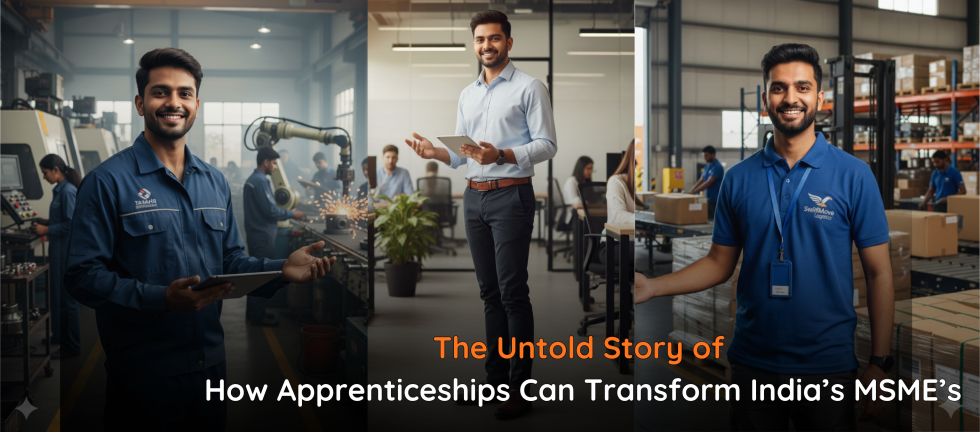
The MSME Opportunity India’s Apprenticeships Miss ()
How Apprenticeships Can Transform India’s MSMEs: India’s MSMEs—over 64 million strong—employ nearly 23% of the nation’s workforce and contribute about 27% to GDP, 38% of manufacturing output, and 45% of exports. Yet many MSMEs struggle with skilled talent acquisition, leading to low productivity and growth constraints. Apprenticeships, though proven elsewhere, are still underutilized in this crucial sector.
By the Numbers: Apprenticeships in MSMEs
- In MSMEs, apprenticeship uptake is low, despite reforms to shorten tenure and raise stipend subsidies to 50%.
- Apprenticeship programs in MSMEs are growing at 30–35% annually, cutting hiring costs by up to 50%, reducing attrition by 10–25%, and boosting productivity 20–25%.
- McKinsey notes that MSMEs are responsible for 62% of employment in India, yet productivity lags behind larger firms—signifying a vast opportunity through structured talent strategies like apprenticeships.
Why MSMEs Haven’t Fully Embraced Apprenticeships
- Awareness Gap: Many owners see apprenticeships as bureaucratic and not tailored for niche MSME needs.
- Operational Hurdles: Small enterprises find establishing training infrastructure and academic linkages daunting.
- Limited Visibility: Success stories from MSMEs are scarce, reducing motivation to experiment with these schemes.
How MSMEs Can Unlock Apprenticeship Potential
To harness apprenticeships fully, MSMEs should consider:
- Short, subsidized apprenticeships: Capitalize on newer schemes offering 6-month programs and a 50% stipend subsidy.
- Partner with TPAs (Third-Party Aggregators): More than 57% of employers are joining hands with TPAs to streamline processes—a leap from 19% previously.
- Shared infrastructure: Utilize Common Facility Centers (CFCs) in industrial parks to pool training resources across MSME clusters.
- Community storytelling: Document and share transformation stories—this builds peer learning and belief in the model.
A Humble Reflection
I’ve seen small local MSMEs grow regionally competitive when apprentices are given clear tasks, mentor support, and a pathway to permanent roles. It’s not about scale—it’s about purposeful integration of learning and work.
Conclusion: Apprenticeships for Inclusive Growth
Apprenticeships are not just for large factories or urban giants—they can be game-changers for MSMEs across India’s towns and villages. When MSMEs embrace apprenticeships, they gain skilled talent, reduce hiring costs, strengthen competitiveness, and drive inclusive growth.
If you’re an MSME owner, CHRO, or industry leader, I encourage you to explore apprenticeships—not as optional schemes, but as strategic workforce assets that can power India’s grassroots industrial engine.
FAQs
1. Why are apprenticeships important for India’s MSMEs?
Apprenticeships help MSMEs gain access to trained, job-ready workers while reducing hiring costs and boosting productivity. With over 64 million MSMEs contributing significantly to India’s economy, structured apprenticeship programs can strengthen their competitiveness and help solve skilled workforce shortages.
2. What is the current apprenticeship adoption rate among MSMEs?
Apprenticeship uptake in MSMEs remains low compared to large enterprises. Although reforms have made apprenticeships simpler and more affordable, many MSMEs are still unaware of the benefits or find the processes challenging.
3. How do apprenticeships benefit MSMEs financially?
Apprenticeships can:
- Reduce hiring costs by up to 50%
- Lower attrition by 10–25%
- Improve productivity by 20–25%
Government schemes also offer up to 50% stipend subsidy, making training even more cost-effective.
4. What government reforms support apprenticeships in MSMEs?
Recent reforms include:
- Shorter apprenticeship tenures (as low as 6 months)
- Higher stipend support (50% reimbursement for certain categories)
- Simplified processes through Third-Party Aggregators (TPAs)
These changes are designed to make apprenticeships easier and more attractive for MSMEs.
5. What challenges prevent MSMEs from adopting apprenticeships?
Key barriers include:
- Low awareness about apprenticeship schemes
- Perceived bureaucracy in compliance and documentation
- Lack of training infrastructure
- Limited success stories, which reduces confidence in the model
6. What is the role of Third-Party Aggregators (TPAs)?
TPAs simplify registration, documentation, compliance, and training coordination. Over 57% of employers now work with TPAs—up from 19% earlier—because they make the entire process seamless and MSME-friendly.
7. Are apprenticeships suitable for small or micro enterprises?
Yes. Even the smallest units can benefit. Micro and small enterprises can:
- Use short-term, subsidized apprenticeships
- Share training facilities through Common Facility Centers (CFCs)
- Rely on TPAs for end-to-end management
This allows them to build skilled talent without heavy investment.
8. Do apprentices have to be hired permanently after the program?
No. Hiring apprentices full-time is not mandatory. However, many MSMEs choose to retain high-performing apprentices because they are trained in the company’s processes and culture.
9. How can MSMEs create an effective apprenticeship program?
MSMEs should:
- Define clear tasks and training outcomes
- Assign mentors or supervisors for guidance
- Partner with TPAs for compliance and implementation
- Document and share success stories to build internal and industry confidence
10. How do apprenticeships support India’s broader economic growth?
By enabling MSMEs to build skilled talent pipelines, apprenticeships enhance productivity and competitiveness across the grassroots economy. This supports job creation, regional development, and inclusive growth, strengthening India’s overall industrial workforce.
11. Are apprenticeships only for manufacturing MSMEs?
No. Apprenticeships are applicable across sectors—manufacturing, services, logistics, retail, hospitality, IT, and more. MSMEs in any industry can tailor apprenticeship roles to their skill needs.
12. What message should MSME leaders take away?
Apprenticeships are not optional schemes—they are strategic workforce assets. MSMEs that adopt structured apprenticeship programs gain loyal talent, reduce costs, improve productivity, and position themselves for long-term growth.